Monday, May 26, 2014

Thyatira - a lot more than meets the eye, and most of it you can’t see


I get the privilege to introduce Thyatira for the purposes of this blog.  I will be explaining not only what Thyatira looked like but how it felt to be there, and hopefully give an accurate representation of the city in ancient times with a background on what the city of Thyatira has been up to since the ancient times.   Following a historical commentary on the city, I will talk about how it is also the fourth city to be mentioned in Revelation.

Pulling into the busy city of Thyatira was not exactly the most thrilling considering most of us were asleep until we heard the call the get off of the bus because we had arrived.  Slowly arising from my seat and leaving the bus I realized that the “ancient” city that I was visiting was not so ancient after all.  Unless they were selling double chocolate ice cream bars back when John and Peter were walking the earth. 

After walking across the busy intersection where mopeds threatened to take out our legs we entered through a large metal gate which opened up an ancient ruin filled with huge stones that looked as though they were very important at one time.  So like clockwork we all met in the middle of the one block parcel of ancient land surrounded by not so ancient buildings and listened to Cenk (pronounced Jenk) our tour guide talk.  As he talked I remembered many things I read in the Mark Wilson book Biblical Turkey.  Thyatira was a intersection point between the ancient city of Pergamum and Bithynia (watchtower garrison), and a central road junction in northern Lydia.  Naturally, because it sits upon valuable ground the city was desired by many which is shown in the following history.  Seleucus I settled the land in 281 BC forming a military settlement.  Then in 190 BC the Seleucids under Antiochus III held the city, then Prusias of Bithynia in 150 BC, Then Aristonicus 133 BC.  The transferring of power in critical cities in this time was not uncommon. 

Some of the snails that cling to the monument fragments today
When Thyatira was a roman city it became very wealthy by selling purple cloth.  Purple die during this time period was very important, it was obtained by smashing snails because it was naturally created inside of them.  The wealthy people were identified by wearing purple because it meant royalty.  The common person wore dust white clothes normally because it was expensive to buy colored clothing and was only for the upper class.  Soldiers wore red to identify themselves as soldiers with power.  There is thought to have been a bronze or metal worker industry judging by some of the buildings found and inscriptions deciphered. Overall, unlike Smyrna, Thyatira has no temples or alters on record.


Now continuing in time, Thyatira was not found until the 17 Century AD by a British man by the name of Paul Rycault when he was visiting the 7 cities of Revelation. Although most of the ancient city is covered by the now modern city there is the one block section that we stood in.  As we listened to Cenk, I began to realize what we were standing on.  It was a church that was built in the 6th century AD that had a cemetery behind it unsuspectingly covering a Roman street, column bases and drums, Corinthian columns that made up a monumental entrance, and the walls of a 6 Century AD Administrative building.   Naturally there was an odd feeling of awe, not the same type of excitement coming from a mountaintop experience, or the acropolis temple views, it was a sense of awe of the unseen.  The seen eluded to the unseen, in that, one unusual block in the middle of the city gives proof that not far underneath many other buildings are the same types of ruins.   

In Revelation 2:18-29, the writer John records the longest letter out of all of the letters to the churches of revelation, to Thyatira.   Some say that it is the longest letter to the most insignificant city.    Verses 18-20 talk about The son of God with eyes of fire and feet like burnished bronze talking to the angel at Thyatira saying he was satisfied with their perseverance.  This goes along with the theme of faithfulness to the end that john emphasize.  Verses 20-23 talk about Jezebel, who represents someone who would draw the people away from the God.  This is where we see some irony used with a bed.  It says that she will be cast on a bed of suffering, when usually a jezebel would be using this bed to seduce men away from their morals.  Then again he talks about being rewarded for your deeds. Verse 24 says “deep secrets” which refers to Gnosticism: the idea of pulling away from the physical and embracing the spiritual. Verses 26-29 highlight the importants of being faithful to the end. 
Thyatira is one of many cites to see, however Thyatira in particular is more like an ice-burg: it’s a lot more than meets the eye and most of it you can’t see.

--Eric

A Trip to a Mosque: A Small Expansion of Understanding


 An important mission of our Cross-Cultural trip to Turkey is for us as students to expand our view of the world through learning of different cultures and to step out of our comfort zones. A key step in this process is our home-stays that were built into the schedule. We stayed with several families, most keeping two of us at a time, in the city of Izmir. We were spread throughout the city with some of us in the center of Izmir, while others were placed with families that were further out. I belonged to the latter group, staying with a family in the district of Karshyaka, with AJ Steinmetz as my roommate.
            My host-family consisted of Ercan (the Turkish ‘c’ is pronounced like a ‘j’) and his wife, Pinar, who was pregnant with twin girls. They were incredibly hospitable to AJ and I, preparing wonderful meals for us, sharing very interesting facts and opinions about Turkey, and even buying us special treats like Baklava and pistachio roles. Pinar’s brother, Emre, also spent a lot of time with us. Emre was very nice and told us a lot about Izmir and various tidbits about the locations we plan to visit on our itinerary. Unlike Ercan, Emre was a Muslim. Although he was very secular, he believed in the Islamic faith and took his beliefs seriously.
            On the night of the 25th of May, it was the anniversary of Muhammad’s trip from Mecca to Jerusalem then Heaven and back to Mecca. This day is one of the most significant days of the year in the Muslim tradition. To have us experience the religious side of Turkey on a significant day for the religion, Emre took us to his mosque in Karshyaka. Earlier, we heard the echoing of the Imam’s, or leader of the prayers, voice from across the district. As we pulled up to the mosque, the voice was being blasted out of the loudspeakers outside the building for everyone to hear. As we walked down the sidewalk to reach the mosque, we saw that there were people outside the mosque giving out free snacks and treats, possibly in order to help attract people to the mosque. As we reached the building, we also saw people outside the entrance on praying carpets, facing the church and inventively listening. Soon we realized the reason for their outside seating was because it was packed with people inside the mosque. After we took off our shoes at the entrance, Emre found us a place to sit in the back corner of the building. This is where I laid my eyes on the inside of a mosque for the first time.
An example of a mosque that is so full that people are worshiping outside the building.
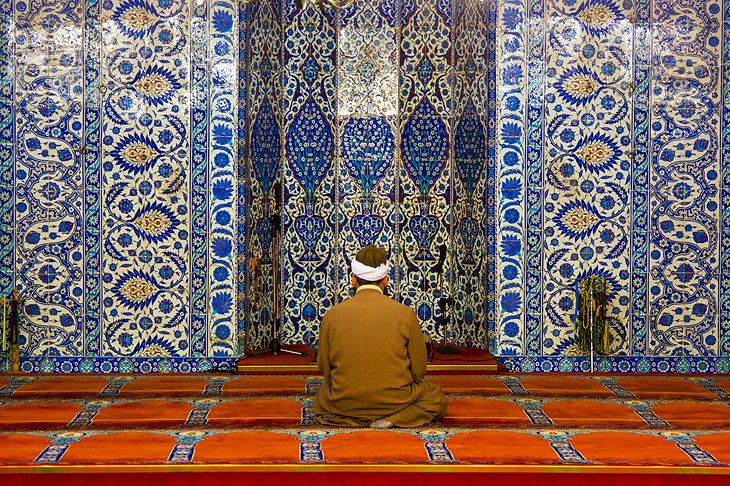
            The interior of Emre’s mosque, which was the largest and most famous of Karshyaka, was stunning. The floor was covered with a bright, ruby red carpet. The walls were lavishly decorated with jewels and brightly colored ceramic designs. Additionally, there was a chandelier that was very large in size and incredibly bright that filled the entire room with light to the point that everything shined with color. This included the “Gate to Paradise”, which shows the direction to pray to by showing the direction of Mecca.
            In front of the Gate of Paradise were too men, the Imam and the Koran reader. The Imam sang praises to Muhammad for a while and then let the reader read the Koran, which he did by singing the text. The reader that night happened to be the best in Turkey and had been scheduled to read that night at Emre’s mosque, which he repeatedly told us how lucky we were for being able to hear him. He read one of the stories of David and his voice sounded very nice and pleasing.
An example of a worshiper facing the "Gate to Paradise" that points to Mecca in Saudi Arabia, the holiest place in Islam.
            In the mosque was mostly filled with men, while women were cornered off into a small section in a corner because in most mosques and women and men are not allowed to pray with each other. The men that we had sat in front of were incredibly friendly. Aj and I, especially me with my red hair and pale skin, stood out as foreigners in the mosque. However, instead of getting angry or concerned looks, we were met with friendly gestures and behaviors and very hospitable attitudes. For example, one man patted me on the shoulder for me to turn around and repeatedly put his hand on his chest and nodded his head in a bowing motion. I did the same to him. Later I found out from Emre that he went out of his way to show me his respect. Additionally, another man asked Emre where I was from and started talking about how he went to America and was interested to see what part of the country I lived in, meanwhile giving me a friendly pat on the shoulder while he was talking about me to Emre in Turkish. While we were leaving the mosque, many of the men we passed gave the same gestures of respect. Even when we were driving back to the apartment, Emre received a text from a man he knew at the mosque, asking how we liked our experience there. This hospitality was a pleasant surprise that reassured the general human kindness that overlaps all different people.
            This experience of going to a mosque was quite an interesting one. I must admit I was somewhat nervous when the idea was proposed to AJ and I and the feeling lasted until we walked up to the building. However, the trip allowed me to have a true, authentic experience at a Muslim mosque in a Muslim country. I feel that this is valuable because of the fact that Islam’s role in the world in a key part of the global stage, both politically and religiously. Getting to actually experience what this religion is like for myself gives me additional knowledge that is important in expanding my understanding of the realities of this world that lie beyond my own national borders.

--Taylor

Living the Turkish Life: Izmir Home-Stays and the Bazaar


Merhaba Everyone!
Today is day 7 of our trip (including the travel days) and the experience has already been incredible, we’ve been through all kinds of experiences and seen many incredible sites. What continues to impress me about this country is the weather as it seems to be the same every day, cloudless and sunny at about 75-85 degrees. One of the most impressive things, however, is how brilliant the sun is here. We were told to bring sunglasses before we came, and I am glad that I did, because I have never seen the sun so bright. Well, enough with the conditions, I’ll go ahead and tell you about some of our recent experiences and my own reactions to some of them.
                We just wrapped up our three-day stay in Izmir and we got to experience some really unique cultural experiences. The main highlight to our stay in Izmir was that we got to stay in the homes of Turkish families. Dan, Eric, Logan and I had to pleasure of staying with Hal, his wife and his daughter. They were very kind and generous to allow the four of us to come and stay with them for three days and show us the everyday life of a Turkish family. One of the biggest things that I noticed while we were there was how similar their way of life is to ours in America. They wake up and get ready, eat a nice breakfast and read the newspaper, then head off to work to get the day going. When we return in the evening we
have dinner and enjoy the company of others while enjoying some soccer on the TV. Sounds really similar to what I would do any day at home in America, and that was really cool to see especially since I had no idea what to expect. One of the things that I did notice to be different was the food (of course I would notice the food!). The food that we had was AMAZING and we were lucky enough to have a host whose mother was a well-known chef! That was definitely a treat and we were able to experience all kinds of different Turkish foods, all of which were delicious. It’s safe to say that our homestay was an overwhelming success, and it was really cool to see the similarities in the way of life between their family and my own.

                While we were staying in Izmir we got the chance to experience the bazaar and all that goes along with that. One of the most unique aspects of the bazaar is that there are no price tags on most of the little shops, so haggling and bargaining is something that you have to get good at. The cool thing is that the shopkeepers actually want to haggle with you, so asking for prices and reasoning about them are things that you actually want to do. You do have to be careful in the bazaar though because a lot of the shopkeepers try to help each other out by sending you to other shops and if you give in to that then you can be stuck running around from shop to shop for hours. So another thing that you have to pay attention to is your body language; all of the shopkeepers automatically targeted us because we were foreign and your body language could really give you away if you weren’t careful. Even as much as slowing down to take a glimpse at some merchandise was enough for them to approach you with a deal, even if you didn’t want to buy anything at all. After a while we learned to keep our eyes ahead and keep walking along if we weren’t interested and at times we would feel rude for being so short with some of the shopkeepers, but we had to keep in mind that that was the way the bazaar worked and these shopkeepers experience this on an everyday basis. One of the really cool things about the bazaar was how all of the shopkeepers knew some amount of English. This is really important for them as they know that tourists can more easily be pressed into a deal than a Turkish person, and for that reason they all know a little bit (or a lot) of English so that they can talk their customers into a deal.

                Being in Izmir was a great experience as it helped me to learn more about the everyday Turkish way of life and I got to experience and try so many new things in these past three days. I am excited for what is in store for the rest of the trip and I am so glad that we still have 2 more weeks here in Turkey! Next stop is Kusadasi for a 5 day stay with trips to Philadelphia, Patmos, Ephesus and many others.
                Thanks for checking in!
                                -Reuben-

Sunday, May 25, 2014

A letter to the church at Thyatira

We next visited Thyatira, and Dr. John Yeatts' devotional is shared with you here.
The ruins in Thyatira have not been as excavated (in part because the town is built on top of it), but we visited what remained.
Thyatira was known for the purple dye that could be made from the snails. I'm not sure if this is a purple snail, but there were a lot of them at the site!

The Witnessing Church IV: The Consequence of Compromise

My father liked to tell me how hard it was to get a job during the Great Depression of the 1930s.  He was a machinist, and there were several applicants for every factory job.  He found employment in a small factory, but even then his situation was not secure.  There were always unemployed persons waiting to take his job.  Since it was not a union shop, if he did not perform, he would be fired, and someone else would take his place.
Converted to Christ in his late twenties, my father came to believe that war was against the teachings of Christ.  As a new Christian, he was particularly zealous for his new beliefs.  As World War II approached, my father took a verbal stand against war, which made him unpopular with the other workers and with his boss. One day the situation came to a climax when he was presented with the blueprint to make a piece on his machine that he knew would be part of a warhead. Should he compromise and do the job? After all, he was not pulling the trigger. Because of his faith and his commitment to follow Christ the suffering Lamb, he refused to run the job, even though he knew that meant he might lose the employment that was so important to him.  His refusal angered his fellow workers and the factory management, who were deeply committed to the popular war effort. For a few days my parents were not sure whether or not he would be fired. Finally, the management decided, because the labor supply was so short during the war, he could remain on the job.  Yet for the duration of the war, he received no increase in salary when others in the factory benefited from raises.
When the choice is between making a living and being a faithful witness to Christ, the message of Revelation is that we choose to be a faithful witness. For my father’s refusal to compromise, he suffered only ridicule and modest financial loss. Many persons have risked their lives by following Christ.  Perhaps you disagree with the stand that my father took; yet, is there anything about your faith for which you would be willing to die? 
My father’s situation is remarkably similar to the situation in Thyatira.  In contrast to Ephesus, Smyrna, and Pergamum, Thyatira was a rather unimportant city.  Ironically, John wrote the longest letter to the most insignificant city.  Thyatira was not a religious or political center.  There was no temple to the Roman emperor there.  Indeed, the city had few temples.  One local hero-god named Tyrimnos became identified with the Greek god Apollo.  A woman named Sambathe told fortunes at her shrine Thyatira.  No real threat of religious persecution or political oppression existed for Christians in this city. 
The difficulty for the Christians at Thyatira was connected to the fact that the city was a center of trade.  Archeological inscriptions mention guilds of workers in wool, linen, leather, pottery, bronze, and baked goods.  Lydia, who was mentioned in Acts as a seller of purple, may have worked for the purple cloth factory in Thyatira (Acts 16:14).  In any case, as a result of the commercial nature of the city, trade unions sprang up there.  It was difficult to get a job if a person was not a member of one of these unions.  Yet the unions held banquets in honor of pagan idols, and served meat dedicated to these gods.  Furthermore, the banquets commonly ended in  orgies of immorality and drunkenness.  The problem in Thyatira was whether or not to participate in these meals.  Could a faithful witness for Christ be a member of a union that required him to attend banquets in honor some idol, eat meat dedicated to that god, and sanction drunkenness and immorality?  Therefore, the Christians at Thyatira were placed in a situation similar to the one my father faced.  Should they witness against the unchristian practices of the unions, or compromise to save their jobs.  The temptation to compromise also confronts faithful witnesses today.
Christ has some advice for the Christians at Thyatira and for us today.  Here, Christ is called, “the Son of God, who has eyes like a flame of fire and feet like burnished bronze.”  The description of Christ’s feet may allude to the bronze industry in Thyatira.  More significantly, this picture of Christ as a strong and stern judge prepares for the stern message that he has for the Christians at Thyatira. 
He begins as usual with a word of praise: “your last works are greater than the first.”  They are improving in “love, faith, service, and patient endurance.”  The majority have kept their faithful witness in this evil environment.  They are not like the Ephesians who had lost their first love.  Yet their concern to love and serve has led to compromise.  Specifically, they tolerate Jezebel, who was probably a leader of the gnostic cult of the Nicolaitans mentioned in the letter to Pergamum.  The name was likely given to an unknown woman at Thyatira who practiced the sin of Jezebel.  Just as King Ahab’s wife led Israel to compromise with the idolatrous religions of their neighbors (1 Kings 16:31-34), so the Jezebel of Thyatira seduced Christians to compromise by participating in the idolatry and immorality of the trade union dinners.  So the sin of the Thyatiran Christians was that they tolerated this Jezebel; they compromised with evil. 
Christ says that some of the Christians at Thyatira were actually spiritual children of Jezebel, honoring the gods by participating in the trade union banquets and the sexual immorality that went along with them.  They had sold out their witness for these evil practices.  Christ’s word to them is: Repent.  Sexual language is used to describe the fate of Jezebel and her followers if they refuse to repent.  Compromising their faithfulness to God is called adultery.  If the seducer Jezebel does not repent she will be thrown, not on a bed of adultery, but on a sickbed.  Those who commit adultery with her through compromise with evil will be in great distress and even may even die.  The seriousness of their sin is characterized in the words, “the deep things of Satan.”  Jezebel and her followers thought they could compromise with the satanic world without damaging their Christian witness.  For this, they receive what they disserve.
On the other hand, Christ has two promises for those who conquer by continuing to bear witness to the end: authority over the nations to rule with an iron rod and the morning star.  Christ himself is the morning star, so the witness who conquers receives the authority of Christ as a reward.  And because these who are faithful have Christ, their witness defeats the powers of the evil nations to rule them with a rod of iron.  The verb “rule” again is literally “shepherd.” Christ will shepherd them with the iron rod.  With Christ in us, we have the ability to conquer the temptation to compromise and to defeat the evil that seduces us. 
In Dickens’s book, A Tale of Two Cities, two prisoners are in a cart headed for the guillotine, a man who is giving his life for a friend, and a small girl.  The girl addresses the other prisoner: “If I may ride with you, will you let me hold your hand?  I am not afraid, but I am little and weak, and it will give me more courage.”  When the cart reaches the spot of execution, the little girl looks up into the man’s face and says: “I think you were sent to me by heaven.”  Christ the morning star was sent to us to help to overcome the temptation to compromise with evil and to be Christ’s witnesses in the midst of a culture that would influence us to do things that damage that witness.
Sing: I Would Be True
 I would be true, for there are those who trust me; I would be pure, for there are those who care;
I would be strong, for there is much to suffer; I would be brave, for there is much to dare.
 I would be friend of all—the foe, the friendless; I would be giving, and forget the gift;
I would be humble, for I know my weakness; I would look up, and laugh, and love, and lift.
I would be faithful through each passing moment; I would be constantly in touch with God;
I would be strong to follow where He leads me; I would have faith to keep the path Christ trod.
Howard A. Walter
Pray:  O Son of God, who has eyes like a flame of fire and feet like burnished bronze, may our works of love, faithfulness, service, and patient endurance be greater than at first.  Help us to repent of our bent to compromise with the deep things of Satan and hold fast our faithful witness so that we will disserve to receive the authority to overcome evil through you, the morning star.  Amen.

Day Two in Izmir... Church and the Beach (we're having so much fun!)


Day two in Izmir and we visited a christian church and then took an afternoon sabbath at the beach. Fun (as expected) was had by all, and you can look forward to seeing posts from the students again after tomorrow's trip to Kusadesi.
The group in front of an Anglican church built by ex-pats which is now a Turkish Baptist church
Michelle, Aly and Amy at the church.
We thought we came to worship with Turkish Christians, but it turned out that their service wasn't starting until noon. Blessed with some musicians in the group (Rachel and Michael pictured here), we had our own impromptu service.
Dr. Yeatts preached on Revelation 5.
And a couple of Turkish brothers who had shown us around the church joined in as well. They sang in Turkish and we in English.
The entire group at Cesme beach, one of the beautiful beaches on the Turquoise coast.
The gentlemen in the group wanted their own picture.


Saturday, May 24, 2014

A letter to the church at Pergamum

On our trip, we are visiting all seven of the churches that are written to in the book of Revelation. The first city we visited was Pergamum, and here Dr. John R. Yeatts talked to us about the significance of the setting of the church in this city. He has shared with the group a small devotional set focused on these seven cities, and we will share them with you here as we visit the churches. We hope you find them interesting.
Dr. John Yeatts in front of the Trajen temple on the Acropolis at Pergamum.

The Witnessing Church III: Satan, Balaam, Nicolaus or a New Name

“I know where you are living, where Satan’s throne is.  Yet you are holding fast to my name.”
            When I was a child, our Sunday School Superintendent told us the story of a young man who had just become a Christian; I’ll call him Jerry.  Shortly after affirming Christ as his Savior and Lord, Jerry obtained a job with a construction crew working a considerable distance from his home.  His Christian friends were concerned about him.  This young Christian would be living with men who had no Christian profession.  They would make it hard for this young Christian to live his new life in Christ.
            Jerry took the job and left home.  After being gone for about a month, he came home for a visit.  His friends were anxious to hear if the faith of their young Christian brother was able to survive.  One of Jerry’s friends asked: “Well, how was your first month on the job?” 
            Fine,” Jerry answered.
            Then the Christian friend asked: “How did your fellow workers react when they found out that you are a Christian?”
            “Oh,” Jerry answered, “they never found out.  I never told them.”
            This young Christian was able to keep his Christian faith intact while living in the corrupting surroundings of a construction camp.  He preserved his own faith in the face of the evil around him.  Yet he did this by hiding his faith.  He did not allow himself to be corrupted by the forces of Satan around him but neither had he taken a positive stand for Christ.
            This young Christian was much like the Christians at Pergamum.  The city was a greater religious center than either Ephesus or Smyrna.  All three were strongholds of emperor worship.  John says they are “living where Satan’s throne is.”  Pergamum became the first Asian city to openly support Caesar worship when a temple for the worship of the Goddess of Rome and the Divine Augustus was constructed.  Indeed, the city became the center of emperor worship for the province of Asia.  Christ is saying that their worship at the throne of the emperor is really equivalent to worshipping at “Satan’s throne.”
Moreover, Pergamum was known for its devotion to Greek gods common in the Mediterranean culture of John’s day.  Many pagan altars were constructed on the hill behind the city of Pergamum.  The most prominent was the altar to the Greek god Zeus, which look like a large seat on the edge of the hill.  Perhaps, this was what John meant by “Satan’s throne.”
Nevertheless, the most significant aspect of the religious life of Pergamum was the shrine for worship of Aesclepius, the god of healing.  The sick from all over the province came to this shrine to sleep in the hopes that the god would come in a dream to heal them.  The serpent was Aesclepius’s symbol, which accounts for its use today as a symbol of the medical profession.  That serpent cult could have been called “Satan’s seat.”  Indeed, Christ could have used “Satan’s seat” to refer to all of the religious practices of Pergamum.
Like the construction camp where Jerry went to work, the Christians of Pergamum lived in surroundings that were hostile to their faith.  Like Jerry, they stood firm in their commitment to Christ.  Yet also like Jerry, they took no stand for Christ.  They rejected the name of Satan but they refused to take the name of Christ. 
Revelation has a message from Christ, who has “the sharp two-edged sword” of the word of God.  What Christ says is the God’s word for Pergamum.  Christ commends them for holding fast to the name of Christ and refusing to deny the faith in the face of opposition and even possible death.  Indeed, at least one faithful witness in Pergamum named Antipas had died for his faith in Christ.  Tradition says that Antipas was roasted in a brazen bull.  Faithful witnesses like Antipas and others in Pergamum are commended here and throughout the rest of Revelation. 
Nevertheless, Christ criticizes the Pergamum Christians for not taking a positive stand for Christ against Satan.   The Satanic teaching in Pergamum is called the teaching of Balaam and the Nicolaitans.  These are probably two ways of designating the Gnostics, who took Paul’s doctrine of freedom from the law to mean that one could freely participate in the culture around them.  They believed that one did not need to be separate from the world in order to be a witness for Christ.  This compromise is the opposite of the situation at Ephesus, where Christians were very good at identifying and rejecting false teaching.  Here they tolerated it. 
Two specific sins were tolerated: eating food sacrificed to idols and practicing fornication.  In Pergamum meat dedicated and sacrificed to idols was then sold in the marketplace.  This was so prevalent that avoiding sacrificed meat was impossible without becoming a vegetarian.  It may be, however, that what is referred to here is actually participating in the idol worship by eating the meat in pagan temples.  Such worship was clearly off limits to the faithful witness.  The second sin was fornication.  In the story of Balaam, the Israelites were seduced into sexual intercourse with Moabite women (Num. 25:1).  Sexual immorality was a concern of the early Christian church, exacerbated by the availability of temple prostitutes.  Yet, it may be that fornication is used symbolically for the idolatry of emperor worship, the worship of Zeus, or the veneration of Aesclepius. 
The Gnostics that advocated these immoral practices believed that the spirit was important and the body was of no significance.  Therefore, devotion to other gods and fornication are of no consequence.  Gnostic even argued that moderate participation in such sins involved greater discipline than total abstinence.
Christ’s response is: Repent or you will be judged by the sword of the word of God. Those who repent and overcome the temptation to compromise with Satan will be given hidden manna, and white stone and a new name.  The Hebrew tradition taught that, when the Messiah comes, the gift of manna provided for the Israelites in the wilderness would be repeated.  So those who do not eat food offered to idols will receive divine food.  There are many possibilities for the meaning of the white stone.  Perhaps the best in this context is that stones were used as tickets to important events.  The meaning then is that faithful witnesses who do not eat food sacrificed to idols are given a ticket to the banquet of God.  Finally, the new name on the stone is the name of God or Christ, who are truly known only by those who are faithful to the end. 
This letter to the church in Pergamum focuses the complexity of participating in worldly practices.  Although Christians today are not tempted to eat food sacrificed to idols, many practices in our world carry the potential for compromise.  The New Testament counsels Christians to be faithful to Christ by living a holy life.  Some practices defile one’s witness and others do not compromise Christian character.  Discernment is needed to know the difference. 
Sing:      Search me, O God
Search me, O God, and know my heart today, Try me, O Savior, know my thoughts, I pray;
See if there be some wicked way in me; Cleanse me from every sin, and set me free.
I praise Thee, Lord, for cleansing me from sin; Fulfill Thy word and make me pure within;
Fill me with fire, where once I burned with shame; Grant my desire to magnify Thy name.
Lord, take my life, and make it wholly Thine; Fill my poor heart with Thy great love divine;
Take all my will, my passion, self and pride; I now surrender, Lord, in me abide.
O Holy Ghost, revival comes from Thee; Send a revival, start the work in me;
Thy Word declares Thou wilt supply our need; For blessings now, O Lord, I humbly plead.
James E. Orr
Pray:  O Christ who speaks with the sharp sword of the word of God, may we hold fast to your name.  Forgive us for when we have denied your name.  We repent of our compromise with the enticing and seductive forces of this world.  May we conquer evil and be admitted to your blessed kingdom.  Amen.
Dr. John Yeatts in the Asklepion theater talking about Pergamum and the letter with the students.
 

We're having so much fun!

This weekend the students are all at home-stays with Turkish families in the Izmir area. All reports we have heard so far indicate that they are having a simply FABULOUS time with their hosts! I thought I would just add some funny pictures from our last couple of days of travel for those who like to see these things.
Taylor, Jared and AJ found an AJ sized hole in the rock. He fit with some assistance...
We have all spent some quality time listening to our guide, Cenk explain the historical context - the fun part is that we have done a lot of the listening in beautiful ancient theaters. Here is the group at the theater in Pergamum Asklepion area.
Again, at Pergamum (on the Acropolis) listening to Cenk, but check out the view!


Logan and Reuben in the cable car on the way up to Pergamum Acropolis

 Jared and Dan at the top of the old elevator in Izmir

 Reuben's new jersey with Cenk's name. Cenk really is the number one fan of Fenerbache football team
- Hannah