Wednesday, May 28, 2014

Sardis!


Walking along Roman roads and sitting in ancient theatres for the past week and a half has put all of our studying into perspective. We know about the stories and the journeys of some of the first Christians: about the preaching, sailing, writing, and falling out of windows. But now we get to be here. We have the privilege of being in these ancient places and standing on ancient stone. We even get a chance to visit all seven cities John wrote to in the book of Revelation. And of all the places we have seen so far, Sardis has really been the most unique.
Settled around 1400 BCE, Sardis is a fairly old city even by Turkey's standards. And it was a strategic city. It functioned as a connection between Anatolia (basically all of Turkey) and the Aegean coast (the body of water between Turkey and Greece). Sardis also served as the capital of the Lydian empire. In an area rich in resources—namely grapes and gold—it easily became one of the wealthiest cities in the ancient world. The wealth of King Croesus (from whom we get the phrase “as rich as Croesus”) came from the gold along the banks of the nearby Pactolus River. Sardis was also strategic militarily—once thought to be an impregnable fortress, it was only over overtaken by stealth. In 546 BC the Persians were only able to take control of Sardis when a soldier accidentally exposed a secret entrance while retrieving his helmet that he dropped outside the city. Later, in 334 BCE, Alexander the Great took over Sardis from the Persians where it also became the capital of the Selucid Empire.
When we entered Sardis, we walked along a Roman road, a road that a major highway in Turkey still follows today. This ancient Roman avenue moves from east to west and is made of a layer of gravel, terra cotta, and stone, often marble. It is shaped like a pyramid so that water doesn’t accumulate, making the path easier to traverse. If that wasn’t enough, the gravel also helped to absorb the water.


Thanks to Cornell and Harvard, archaeologists have been able to piece together what would have been the gymnasium and the synagogue. The gymnasium and bath complex is a massive structure that would have been used only by men for physical exercise and for training for events such as running and fighting. The boys who trained in these gymnasiums often turned into very good soldiers. The place in which they would have exercised is the large open courtyard known as the palaestra. Within the structure itself was where the bath was located, which consists of a long, but shallow oval pool that would have once been filled with water. Along the outside of the palaestra used to be classrooms where the male students would go to their studies after a long morning of exercise.


The entire gymnasium and bath complex with the palaestra (the grass area) in front

The bath area--the students are walking in the oval pool

 The other major structure we saw was the synagogue, which is thought to be the largest synagogue of the ancient world outside of Israel. Sardis has a unique place in the history of Jews in Turkey. In 220s BCE, nearly 2000 Jewish families moved into the area from Mesopotamia in order to provide more workers for the city. The second wave consisted of Sephardic Jews who moved into the area in the 1490s due to religious persecution in Spain. The third wave occured in the 1930s when Ataturk invited Ashkenazi Jews into Turkey. 

The synagogue--note the wonderful floor mosaics


When we walked into the synagogue, there was an ancient Christian symbol etched into the stone on the ground:


If you were to break it apart, the wheel represents 5 Greek words, Jesus, Christos, Theos, Huios, and Soter, which translates to Jesus, Christ, God’s Son, Savior. We can find the first letter of each of these words in their Greek form hidden in the wheel. These words, in turn, create the acronym Ichthus, which means fish in Greek. This symbol is closely related to what we call the Jesus fish, which was another ancient Christian symbol with a very similar meaning.


Here is my colorful attempt to show the hidden letters in the wheel


As we sat in the synagogue, we had the fortune of listening to Dr. Yeatts talk to us about the letter written to the Sardis church in the book Revelation. It is quite amazing to be able to use our knowledge of the history and geography of Sardis to understand the biblical passage, For example, when John warns the church of Sardis in Revelation 3: 1-6 that “if you do not wake up, I will come like a thief, and you will not know at what time I will come to you,” we can compare it to Sardis’ history as a city people once thought was invincible (Rev. 3:3). Like I mentioned above, Sardis was a city overtaken by stealth. In the same way, the church of Sardis needed to remain vigilant for Christ will come when they least expect him.

Haley Lerner
The entire group in front of the gymnasium and bath complex

Izmir: A Modern and Traditional City

Izmir is the city that our group had the pleasure of experiencing for three days. Some of this time went to visiting the sites of Smyrna, the ancient city found in the book of Revelation, which now mostly lies in its grave underneath the modern city of Izmir. This city is the third largest city in Turkey with over four million people, ranking behind the cities of Istanbul and Ankara. It is located on the west coast of Turkey, in the middle of the country’s range of latitude. The city is also incredibly vast, spanning over twenty-eight thousand square miles! Instead of having many skyscrapers and very tall buildings that house the population like in the U.S., Izmir is built outward over seemingly countless hills farther than the eye can see.

The reason for the large area of cities like Izmir and Istanbul is credited to Alexander the Great. When he conquered western Anatolia, which is the name of the land that Turkey resides on, he wanted to make the cities of the land strong and powerful since they were near the edges of his empire and would be under threat of opposing forces. In these times, having more land meant having more power. This caused Alexander to order the cities to expand as far and wide as possible, and the trend continued to into the formation of the modern cities that travelers enjoy today.
The Market Place in Izmir
I learned much about the city from the people I spent my home-stay with, in the district of Karsiyaka. Ercan, my home-stay “father”, explained to me that Izmir is a large trading city. This is because of it having the second largest port in Turkey that leads the country in quantity of exports every year. These exports often include dry fruits like apricots and raisons, leathers, and textiles, such as carpets, that are shipped all around the world. Ercan continued to express that you will not find as many high-end materials to buy like you would in Istanbul but what you will find are many experiences and great food, especially near its large harbor.

To see the beauty of this harbor, our group used the first elevator ever built in Izmir. The elevator was built decades ago in order to replace two hundred and fifty steps that civilians of a district elevated higher in the city would have to walk every day. The large elevator is still often used by the people of that higher area of the city to travel down to the lower main districts. Its height provides for a wonderful view of the harbor and the entrance to the gulf of Izmir.

A view of the harbor from the elevator
While looking at the harbor, you can see multiple Turkish military destroyer ships cruising through the water. The military presence, like many places in Turkey, is quite common. This is because of the size of Turkey’s military, ranking as the second largest in the world, falling only behind our own United States in military strength.
A military boat in the harbor.
Izmir is located on a fault line, which makes earthquakes common there. During our time in the city, there was a small earthquake that lightly shook the city. However, most of our group that was walking outside had no idea about the event and only people in stores and cafes could see its effects. This small earthquake did not do any harm to anyone or damage to the city, and most people had no concern over it at all. However, earthquakes can be a deadlier occurrence, especially for certain poor people of the city. Decades ago, in minute parts of the city that hold the very poor, neighborhoods of buildings were built in just a couple days at a time. These buildings, obviously very poorly built, are notorious for collapsing during any earthquake with significant force, often killing their residents. The government is currently trying to move these people to newer, safer houses and to destroy the old ones that are unsafe and are also covering archeological sites of Smyrna.

Our group was able to spend a lot of time in the heart of Izmir, visiting towns like Konak and Alsancak that have very different atmospheres. We spent hours shopping in both of these areas in order to purchase authentic Turkish items and experience shopping in a bazaar. In Konak is where we spent hours in a bazaar, searching through thousands of shops that packed every corner of the streets. These shops held wide ranges of items consisting of 3 lira bracelets and trinkets to diamonds larger than my head. The shop owners were very aggressive, calling out to you as you walked by or even following down the street and waiting for you outside other shops to continue to try and lure you to their shops. Alsancak was very different. Being one of the wealthiest districts of Izmir, it has a more western feel to it. The streets are set up in a typical western style just like a wealthy part of any city like Washington D.C. or Paris. The shops consisted of western stores like typical book shops and Starbucks, as well as high-end wedding dress shops and clothing apparel stores.

Wandering around the shopping district of Izmir

The western atmosphere of the city is symbolized on its waterfront. Here, a statue of Ataturk, the founder of the Republic of Turkey, with other Turks on horseback are displayed riding toward one side of the harbor. This is the west side, symbolizing Turkey’s destiny of transformation from an Eastern identity to a future of Western living.

The waterfront statue of Ataturk and friends pointing westward
Emre, Ercan’s brother-in-law, expressed very passionate positivity toward Izmir, repeatedly stating the many reasons of why Izmir was the best city in Turkey. He would talk of how the people of city are much friendlier than other citizens of cities like Istanbul, which is a much more cut-throat town. Likewise, Izmir is less dangerous than other cities, having people walk in parks at times of night that would mandate clear paths elsewhere. Emre especially emphasized Izmir’s secular culture. Although most of the city’s residents are Muslim, the majority of these are very secular, or how Emre describes, “modern” Muslims. Additionally, many of the nation’s Christian and Jewish populations live here as well.

This all shows the modernity of the city that has developed throughout the country, especially the western end of it. Izmir is a city that gives a modern atmosphere like Istanbul but also provides a larger blend of Turkish culture from being further into the land of Anatolia. This blend allows the city to be a nice stop for a traveler to get a sense of both the modern and traditional side of the country.
Taylor Schock

A Sincere Welcome


When I signed up for this cross cultural trip to Turkey I did not know what I was getting myself into.  Considering it was the first time I left my comfortable life in the United States and entered into another country’s culture.  As I watched the Health and Safety video and the Cross Cultural Awareness video I felt overwhelmed and unsure of what I was about to experience in the coming weeks. Then the day came when we traveled ungodly amounts of hours on busses and airplanes, finally I arriving in Turkey with 30 unfamiliar faces.  The one thing that I wanted was the one thing that I could not find, familiarity, the word that describes my whole life at home, now inherited two small letters in the front of it, Unfamiliar.   This word has new meaning for me now that have been in Turkey for 8 days.  The Unfamiliarity is something I am getting accustomed to as we travel to new places every day.  Unfamiliarity means that I am growing and learning. 

In Izmir Reuben, Dan, Logan and I stayed with a family for three days and experienced something amazing.
Izmir as seen from the old elevator
All four of us got out of the small bus that we were herded into to go in a separate way than the other half of the group to save time.  We crossed the street to be met by Hal and his young daughter.  “Merhaba” we all exclaimed, which means hello in Turkish, and Hal responds “hello” with a big smile.  Hal leads us to the small elevator and told to go to the sixth floor of their apartment building where his apartment is.   I walked into the apartment met with a huge smile and a “welcome” from Hal’s wife as she led us to our rooms to put our bags in.  After all four of us hauled our luggage into our rooms our host family met us in the living room to chat.  The first thing Hal did was introduce his wife, who was pregnant, and his daughter.   He exuded happiness when looking and interacting with them as though he was extremely proud of his family.  Then he brought us into the kitchen and said some things that really made me think.  He said in is Turkish accent “This is your house now, this is your family”.  I have visited many friends’ houses in the states and even friends of friends’ houses and never have received such a welcome as Hal just gave us, “This is your house now, this is your family”.  I think this statement speaks volumes of what I experienced of Turkish hospitality.  

This profound experience in Izmir, across the world from everything familiar certainly has changed my perspective on cross-cultural experiences, hospitality, and family.  Although I don’t own a home or have a wife and a daughter, I can learn from my homestay experience.  The welcome I received is one that I would love to recreate and give to everyone I come in contact with regardless of perceived differences.  There are so many things about the Turkish culture that I love.  First being the hospitality, and another being the family value.  Hal was so proud that his wife was pregnant he probably told us 15 times during our stay.  The incredible look in his eye when he saw his daughter drawing pictures with Dan and throwing a ball to Logan in the living room, made me think about how much I love my family.  I know that the family we stayed with is just one of millions in Turkey and I have experienced several families in United States, but I think that Hal had something right.  Family is forever and we might as well enjoy it to the greatest extent.  I heard someone say once; “if you love something, you can’t help but talk about it”.  Hal talked about his family all the time which showed his love brightly.

My take away from the first 8 days in Turkey is; embrace the unknown because it’s never as frightening as it seems.  This place of unfamiliarity is where I learn the most, sometimes it looks like going to another country, sometimes it’s welcoming guests into my home as family, sometimes it’s being proud of your family and eventually it will be going back home to work a new job for the summer, regardless of what it is, God wants to work powerfully through it.

- Eric

Tuesday, May 27, 2014

From Izmir to Smyrna

For the last few days we have been in Izmir, Turkey’s third most populous city. As interesting as modern Izmir is today, its former name—Smyrna—is just as interesting. My post will focus on the ancient city of Smyrna, its famous Agora, and the city’s biblical significance.
The ancient agora next to the modern Izmir.
Although much of it is now literally under the current city of Izmir, Smyrna boasted a grand market, a crucial seaport, temples to Roma, Nemesis, and Athena, and even one of the first Christian Martyrs. Thought to be the hometown of Greek poet Homer, Smyrna was originally established in the 11C BC. It was later destroyed in 600 BC but rebuilt by Alexander the Great in the fourth century BC (although there are multiple theories regarding its re-founding). Similar to Izmir today, Smyrna was home to a marvelous agora—a public space for markets and civic activities. The agora in Izmir is one of the best preserved and most excavated in the Anatolia peninsula.  Because Smyrna was a major seaport in the ancient world, the market, or bazaar, was very large, hectic, and most likely contained a wide variety of goods. The one we see today was built somewhere around 178 AD after previous agoras had been destroyed by earthquakes. And because it would have been a popular destination, it had to be big; this one was likely three levels and contained a considerably large courtyard. Mark Wilson measures it to be approximately 120x80 meters (or 394x263 feet). And while there is no doubt there would have been plenty of merchants present in the agora, Wilson suggests that it was home to important political activities as well.

A fun discovery made by archaeologists was Christian graffiti etched in the walls. Some inscriptions reference “the Messiah” or reference Jesus as Lord. Some are even simple markers to let others know they were there—“Claudius was here.” There are even inscriptions that resemble the modern love-letter graffiti we see today (“Claudius loves Faustus”). This just goes to show that even though we have changed so much over the last 2000 years, we really haven’t changed at all.
  
Soon this new Graffiti Salon will be open for everyone to see the new discoveries, but right now it's still being prepared.
A sneak peak into the salon

The seaport and its massive agora helped form an important economic influence that made it the significant city it was. Smyrna was the fist city to establish a cult of Rome, evidenced by the temple of the goddess Roma built at the end of the second century AD. This city was in a constant race with Ephesus and Pergamum to be known as “the first of Asia in beauty and size.” In terms of power and wealth, Smyrna was quite a formidable city  that demanded respect both from other nations and from Caesar.  
As you can see, the marketplace/public square was quite large even by today's standards.

In the ancient world, there would have been a connection between the name Smyrna and death. Myrrh, an incense commonly used to mask the odor of the dead, is a Greek word very similar to Smyrna. So, when one thought of the city of Smyrna, one must have also made some mental connection to death.[1] This is quite a coincidence because the Christian community in Smyrna was supposedly heavily persecuted. As I mentioned before, this city was home to one famous execution of the Christian martyr, Polycarp. Rather than offering a pinch of incense to Caesar and muttering his lordship, Polycarp responded to the threat of death by fire, “You threaten with fire that burns for a time, and is quickly quenched, for you do not know the fire that awaits the wicked…Come, do what you will.”[2] It is believed that his death helped fuel and inspire the Church in Asia Minor. Unfortunately and undoubtedly, Polycarp was not the only Christian to die for his faith. In Revelation we read that Jesus said to the church in Smyrna, “I know your afflictions and your poverty….Do not be afraid of what you are about to suffer…you will suffer persecution for ten days. Be faithful, even to the point of death…”[3]
Catholic Church in Izmir dedicated to Polycarp
 Persecution was not only coming from Rome, though. It is likely that even the Jewish community had a hand in oppressing Christians. John Yeatts suggests this is because Christians were winning converts from Judaism. More importantly though, at least for the Jews, “they were afraid of losing [exemption from Caesar worship] if other groups wanted similar exclusion.”[4] Even though the city was wealthy and prosperous, life as a Christian was not. 

AJ expertly deciphering Greek inscriptions
Like Izmir is today, Smyrna was a thriving community with a peak population nearing 100,000. [5] Its economy was fueled in part by its strategic placement near the sea and its expansive marketplace. It was a prominent city in the ancient world and it was quite the prize of the Roman Empire. It was also home to one of the most profound and inspirational deaths in the early Christian Church. 

--Chris Williamson 


[1] Mark Wilson, Biblical Turkey: A Guide to the Jewish and Christian Sites of Asia Minor, 390.
[2] John Yeatts, “Worship and Witness: The Devotional Revelation”, pg. 4
[3] Revelation 2:9-10
[4] Yeatts, “Worship and Witness”, pg. 4
[5] Mark Wilson, Biblical Turkey, 391.

A letter to the church at Smyrna


Our third city visited was Izmir, the ancient Smyrna. Here we visited just a small section of the ancient Agora, or marketplace, and John again shared with us about the letter to the church.
The Witnessing Church II: Safety for Suffering Saints

“Be faithful unto death and I will give you the crown of life.”
            Eusebius of Caesarea, recognized as the “Father of Church History,” describes the tradition that grew up around the martyrdom of Polycarp, a bishop of the church in Smyrna, who was in his twenties when Revelation was written.  Polycarp was taught by the apostles who had actually seen Christ and instructed others in the doctrine he had learned from them.  A letter from Polycarp’s churches described grotesque persecutions of victims that revealed inner body organs and exposure to wild beast.  As a result of these persecutions, Polycarp retreated to a farm outside the city where he prayed and received a vision that he would die in flames.  His persecutors found him by torturing two boys to force them to reveal his whereabouts.  When his persecutors arrived, he prepared a table for them and begged that he might pray for one hour.  Some who heard him pray repented. 
            After he finished praying, he was conducted on the Sabbath to the city where he met Herod and his father.  They implored him, “What harm is it to say, “Lord Caesar and to offer sacrifice and to be saved?”  When Polycarp responded, “I am not going to do what you council me,” they threw him from the vehicle in which they were traveling, and he sprained his thigh. 
            Polycarp was then taken to the city stadium where the proconsul encouraged him: “Swear by the genius of Caesar, repent.”  Polycarp refused.  When the proconsul threatened to throw him to the wild beasts, Polycarp responded, “Call for them.”  Upon being threatened with fire, he affirmed: “You threaten with the fire that burns for a time, and is quickly quenched, for you do not know the fire that awaits the wicked … everlasting punishment.  But why are you waiting?  Come, do what you will.”  The crowd in Smyrna cried out that Polycarp should be burned alive and gathered wood and straw for the flame.  Polycarp asked that he not be secured with spikes so that he could bear the fire without restraint. 
            After the fire was kindled, the flames surrounded him like an oven so that they did not consume him but purified him like gold or silver in a furnace.  Moreover, the persecution fire gave off a fragrant odor like incense.  When the executioner realized that the fire would not consume the victim, he plunged his sword into Polycarp.  So much blood gushed out that the fire was extinguished.
            Eusebius affirms that Polycarp’s death inspired others to undergo death for the cause of Christ.  Indeed, the message of Christ in the letter to the persecuted church at Smyrna has been a comfort to all who are persecuted throughout history: “Be faithful unto death and I will give you the crown of life.”  The persecution in Smyrna came from two religious groups – the worshippers of Caesar and the Jews.  Smyrna was the first city to erect a temple for the worship of Rome.  Each citizen was required to burn a pinch of incense and say, “Caesar is Lord.”  At times, certificates were issued that were necessary for buying food for survival.  So, much pressure was put on Christians to worship Caesar.  Christians were also persecuted by the Jewish population in Smyrna.  The Roman government had granted Jews exemption from Caesar worship, and they were jealous of that exemption.  Perhaps they were afraid of losing it if other groups wanted similar exclusion.  In addition, Christians won converts from Judaism. 
            We do not know much about the church in Smyrna, but we do know from Revelation that it was standing firm in the face of intense suffering.  Yet Christ has advice for the church at Smyrna that is also relevant for any Christians that are suffering persecution.  Christ says: “I know your affliction and your poverty.”  The word “affliction” means pressure or crushing weight, and is the used for the great tribulation.  Therefore, the suffering of the Smyrnans is part of the great tribulation that comes upon the whole earth.   This affliction reduced them to “poverty,” which means absolute destitution.  Their stand against emperor worship made it difficult for them to earn a living.  Moreover, they were slandered by the Jewish population of Smyrna.  The word “slander” is literally “blasphemy,” a word that means defamation or abuse.  Clearly, the Smyrnans can serve as a model for persecuted Christians today. 
Christ’s word to all who suffer persecution is: “Do not fear.”  Persecution made the church at Smyrna so strong that Christ had only praise and no criticism for them.  Jesus says elsewhere that those who we follow him can expect persecution, but that persecution can be strengthening.
Nevertheless, tribulation should not be taken for granted.  Christ attributes persecution to the devil, the slanderous adversary who lies and deceives.  Christ warns that the devil will throw some of them into prison, where beatings were likely.  Christ says that the purpose of the persecution is for their testing.  God allows the devil to test the faith of Christians to give them the opportunity to demonstrate their commitment to Christ.  But the affliction is only for “ten days.”  Time is often used symbolically in Revelation.  Ten days refers to a short period.  The message is: “Hang in there!  It will be over soon.”
If they do hang in there and are faithful even to the point of death, they are promised a “crown of life.”  In the athletic events held in the stadium of Smyrna, the victors were not given a trophy or a medal as they are today.  They were given a crown consisting of a wreath of leaves.  In contrast, Christians in Smyrna who are faithful to Christ in the face of persecution from Rome or the Jews will win for themselves a crown of gold.  But the crown is symbolic of something far more important – life, eternal life. 
The negative way of saying that they will receive eternal life is that they “will not be harmed by the second death.”  The first death is physical death.  We are not promised immunity from the first death; indeed, all of us will die physically.  The second death is the judgment of God and eternal punishment.  Nevertheless, those who are faithful even to the point of physical death will not experience the second death.  Indeed, the promise of eternal life means the avoidance eternal death.  The faithful witness who overcomes persecution will escape eternal punishment.  No wonder Christ says: “Do not fear.”  The persecutors have no power over the second death.
So what is the message of the letter to Smyrna for us today?  If we faithfully witness to the crucified Christ, we can expect similar persecution.  Nevertheless, Christ says to us: “Do not fear.”  Our tribulation will be over soon.  When evil is all around us, in our darkest hour of depression, fear, and anxiety, Christ assures us that if we faithfully endure the persecution, we will receive a reward that will last – eternal life. 
 
Sing: "Jesus, I My Cross Have Taken"
Jesus, I my cross have taken, All to leave and follow Thee;
Destitute, despised, forsaken, Thou from hence my All shalt be.
Perish every fond ambition, All I've sought or hoped or known;
Yet how rich is my condition! God and heaven are still my own.
Let the world despise and leave me, They have left my Savior, too.
Human hearts and looks deceive me; Thou art not, like them, untrue.
And while Thou shalt smile upon me, God of wisdom, love, and might,
Foes may hate and friends may shun me; Show Thy face, and all is bright.
 Man may trouble and distress me, 'Twill but drive me to Thy breast;
Life with trials hard may press me, Heaven will bring me sweeter rest.
Oh, 'tis not in grief to harm me While Thy love is left to me;
Oh, 'twere not in joy to charm me Were that joy unmixed with Thee.
Haste, then, on from grace to glory, Armed by faith and winged by prayer;
Heaven's eternal day's before thee, God's own hand shall guide thee there.
Soon shall close the earthly mission, Swift shall pass thy pilgrim days,
Hope soon change to glad fruition, Faith to sight, and prayer to praise.
Henry Francis Lyte
Let us pray the words that John Calvin wrote to a friend after the death of Calvin’s wife:  May the Lord strengthen me by his spirit, and may he support me also under heavy affliction which would certainly have overcome me had not he who raises the prostrate, strengthens the weak, and refreshes the weary, stretched forth his hand from heaven to me.  Through the name of Jesus Christ our Lord, Amen.

On Tomatoes, Old Stuff, and Lesiure

By Dave Carter


                I have always had mixed feelings when biting into a tomato.  I never got caught up on the philosophical origins on the red plant’s family history being either a fruit or vegetable.  I was never sure if I liked them.  My time in Turkey thus far has taught me a valuable lesson on my own tastes.  I do in fact have a conditional love of this fruit/vegetable.  I enjoy the way they taste under the condition that they are fresh from a garden, not fresh from some back of the restaurant refrigerator.  How did I learn this?  Through experiential education.

Part of our breakfast buffet at one of the hotels
                 You may be wondering what an Adventure Education major’s views are on this journey through Turkey.  You may also be wondering what an Adventure Education major is.  Well let me first clarify the second pondering first.  Adventure Education is a legitimate major at Messiah College.  We utilize adventure activities like backpacking, team building, canoeing, caving, etc. as a catalyst for further learning.  We play but also reflect on what we learned through that experience about ourselves and about our interactions with others.  While doing this we had required classes like rock climbing, canoeing, caving, a wilderness encounter to either the Texan desert or Hawaiian islands.  Jealousy is not the topic for today so let’s move on. 
                Through my time studying/playing I have become a large proponent for experiential education as a supplemental source for learning.  Physically engaging with the subject you are studying greatly enhances learning for many individuals.  Over the past week we have visited almost all seven churches of Revelation.  We could have studied these letters in a class room, written extensive research based documents but we chose to leave our national borders and travel to Turkey.  There is something to be said about reaching out and touching the rubble of what once was and what is still read about.  We have heard the words of Revelation while sitting in the shadows of ancient pillars and walls.  
I am still processing how this impacting my Biblical view but this trip has already impacted my world view.  We had the experience of living with Turkish families for three nights.  We shared meals and stories with them.  We exchanged tales of our home life, compared our sports, agreed that football (soccer) should be more popular in the United States, found out how to use a beday, eaten lamb kabobs, and so much more.  This is how you should learn culture, learn a language.  Experiential education causes us to rub elbows with the people we would study in a class room.  We are eating the foods some people only read about.  During my homestay I was woken to the song of the call to prayer from the local mosque pouring through the open apartment window.  You cannot understand the extent of a culture being described as hospitable until you sit on the terrace of a Turkish apartment eating stuffed eggplant and grape leaves until your host mother believes you are full.  It is at this breakfast table where I reevaluated my opinions of the tomato.
Temple to Trajan in Pergamum
While engaging with the people of Turkey I have started to reflect on my own vocation and specialization of Adventure Education.  These adventure activities and my future job potential are directly related to how our culture responds to leisure.  I am a firm believer that you should pursue what you love but you need to be practical.  The reality of not being able to be anything you want to be when you grow up is a stark reality.  We each need to consider what brings us joy and how that can be pursued in our everyday life.  Leisure should not be the reward or sole reason for our working.  A culture trapped in this mindset develops amazing technologies that create wondrous opportunities and wondrous paradoxes.  We have never been so connected to the world as we are now through the advances in the internet and global communications but we are losing the nuclear family, children are growing up instant access to answers without the need to learn.  Our green places are being developed and ostracized as mysterious places without wi-fi access.  Our vegetables come from cans and frozen food isles not backyard gardens.  Where did the tomato on this Big Mac come from?
   This was never meant to be a soap box.  This is meant to be a reflection of my experience thus far in Turkey.  Turkey wishes to continue its push towards Westernization.  As I sit on its beaches, eating home grown tomatoes for breakfast and sipping tea I wonder what I will learn next.  As I earn final three credits for my undergrad I ponder on the applications of Paul’s letters, on John’s letters to the seven churches, to my own walk.  As I contemplate two more weeks in this beautiful country I worry about my own future and when Turkey will start canning its tomatoes.


Pergamum


The ancient city of Pergamum, which in Greek means “citadel”, is located currently in the Turkish city of Bergama. Bergama is located about 70 miles north of Izmir, or Smyrna in ancient times. The highest point of Pergamum, known as the acropolis (acro means highest point and polis means city), stands around 320 meters high. To the west of the acropolis there is the Selinus River and to the east is the Cetius River. On top of the acropolis stands what is called the upper city. On the side of the acropolis, there was a middle city and down in the valley, where Bergama is, is where the lower city would be.
The Acropolis of Pergamum as viewed from the modern city of Bergema
The church of Pergamum was one of the seven churches that John wrote to and we can find this letter in the book of Revelations 2:12-17. In verse 13 it says, “I know where you live—where Satan has his throne. Yet you remain true to my name. You did not renounce your faith in me, even in the days of Antipas, my faithful witness, who was put to death in your city—where Satan lives.” Antipas is known as the first martyr of Asia and according to tradition he was slowly roasted to death inside a bull around 81-96 AD.

In that verse though, it mentions “where Satan has his throne.” John in this passage is referring to something in Pergamum. We know that this throne is symbolic of something because Revelation is written in symbolic language. Sometimes direct language cannot accurately describe all the attributes of God, but metaphors and symbols can give us a picture of God without defining God as something worldly. After visiting Pergamum and learning about the all the things in the acropolis and the nearby city, there are a couple things that John could be talking about. One option and the most popular option is the Altar to Zeus. Now in Pergamum, the Altar is not actually there, it is in the State Museum, formerly the Pergamum Museum, in Berlin, Germany where it has been completely put back together. It is 117 feet wide, 110 feet tall, and 40 feet high and the steps to get to the altar were 66 feet wide. Inside the building, there are friezes depicting gigantomachy, or the struggle between the gods and the giants (their enemies). Since it is an altar to the god Zeus, there was 24 hour sacrifices so smoke could constantly be seen coming up from this building. After the meat would be sacrificed to Zeus, it would then be sold in the markets along with other meat that was sacrificed to Trajan (I’ll talk about him in a bit). It is easy to see how the Altar to Zeus may be seen as a throne. The constant sacrifices of another god could have been what John meant by “throne of Satan”
http://www.musicweb-international.com/Aho/Pergamon_Alt_of_Zeus.jpg
Here is the altar to Zeus, sadly located in Berlin and not in Turkey today. You can see how its shape might have evoked thoughts of a throne.
Part of the foundation of the Altar to Zeus is all that remains in Pergamum today. 
Another possibility could have been the Trajan Temple also built in the upper city. The Trajan Temple started to be built at the end of the first century, and it was finished in the beginning of the second. It was dedicated to the Emperor Trajan. Usually temples were created for worship of the gods, but during the first century, the emperors began to be worshiped as divine as well and remnants of Caesar worship can still be seen all over Turkey today. The temple is a sight to be seen. It is built on the side of a steep hill, and so before the temple could start to be built, they had to build the platform first. Underneath the platform, there is a complex water drainage system of drains and pipes in the structure to keep water off of the top of the platform. The platform was supported by arches. Here at the Trajan Temple, sacrifices were being offered to the Emperor Trajan. This temple may be considered the throne of Satan because it was a place where gods were worshipped, and the platform and the temple itself could be seen as a throne on the side of the acropolis.
The Trajan temple was built on a slope, the bulk of the foundation is supported by arches on the side of the hill.
The third possibility, and perhaps a different one, is the Asclepion. The Asclepion was a renowned healing sanctuary of Asclpeius, the Greek god of healing. Asclepius was always depicted with a serpent, usually around a staff that he carried. This is where we get the shield and snake from on ambulances. The Asclepion is located a little ways outside of the acropolis. Here at the Asclepion, physical ailments were seen to be caused by mental illnesses, so if the mental illness was healed, then the physical illnesses would also be healed. Patients would be led to a dark, underground tunnel with no lights besides the light at the end of the tunnel. The patients would walk slowly towards the end of the tunnel. As they walked, steamed water and opium would rise up from underneath the walkway down the tunnel and it would consume the whole tunnel. Doctor’s above would encourage the patients to keep going and would meet them at the end of the tunnel. Then they would be led to an enclosed circular building where patients would walk in circles talking with the doctor until the doctor would tell them it was enough. Water would also be running underneath the walkway again, to relax the patient. At this facility, there existed other things as well. There was a Sacred Spring where water still flows today, a temple of Zeus-Asclepius, a stoa around the courtyard for the sick to congregate, and a Roman theater. The theater seats around 3,500 people and has now been fully restored by archaeologists. Pictures of this theater will show you that it may resemble a throne. This healing facility relied on physical remedies for healing instead of relying of Jesus Christ for strength. Also, a symbol for Satan has been a snake before in Genesis, so a serpent may be a symbol that they connected with the devil’s presence.
The Asklepion had several temples, and theaters, and healing centers. This is the circular hallway used for psychotherapy.
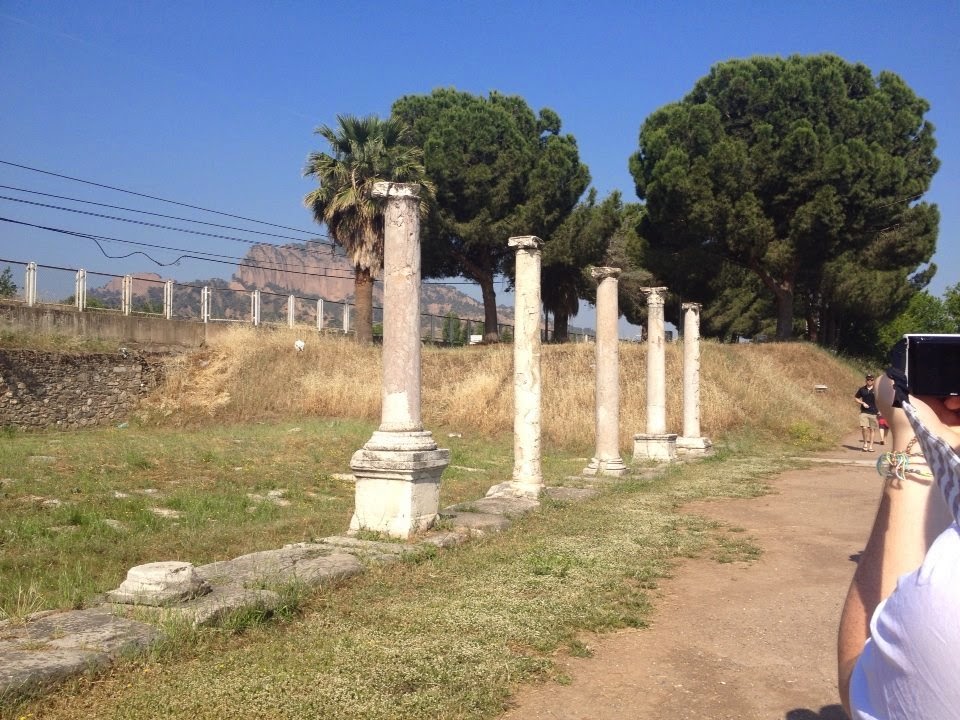
The road to and from the Asklepion was lined with columns. From the Asklepion you have another good view of the acropolis.
Drew Pagenkopf